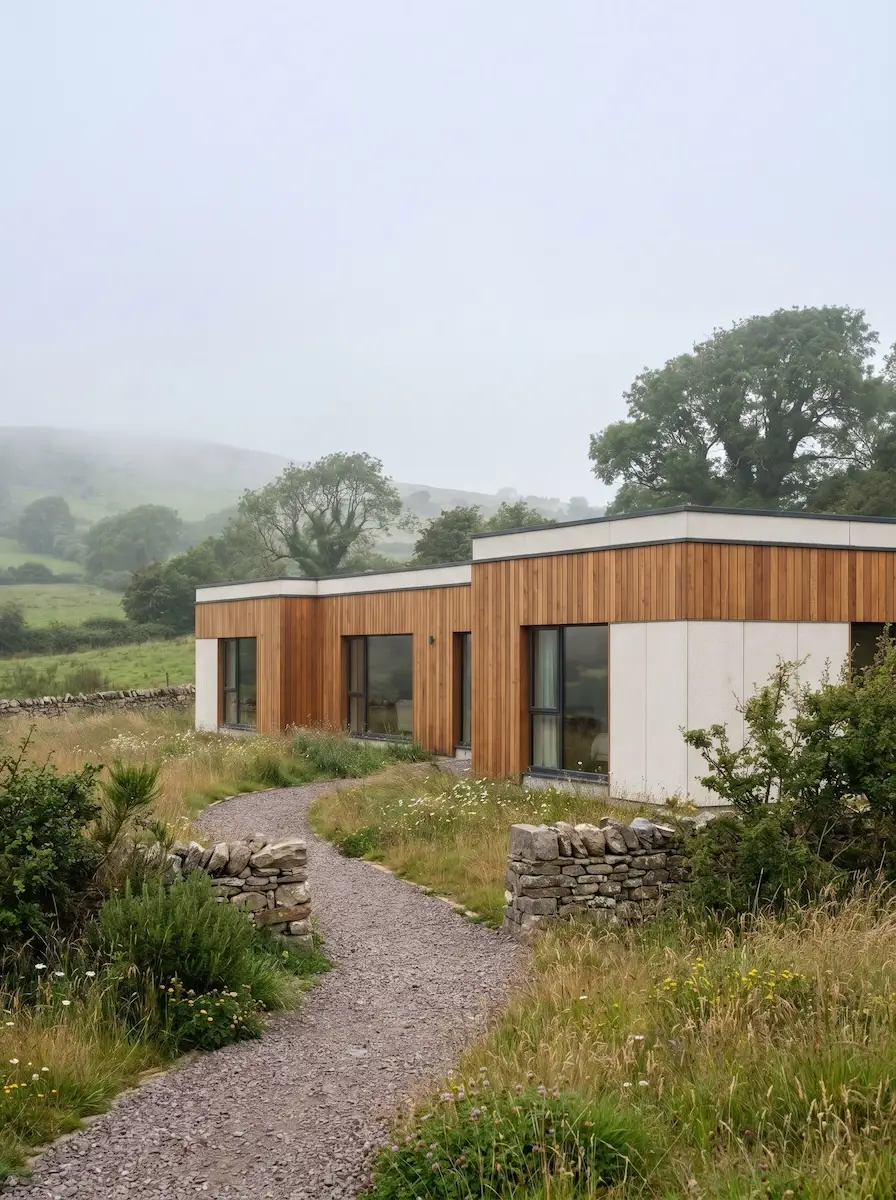
Start with the site, not the house
A rural site in Ireland is rarely a blank rectangle. It comes with a ditch along one edge, a gate in an awkward corner, a slope that runs the wrong way for drainage, and a view that everyone in the family has already decided is the important one. There are mature trees that should stay, a prevailing wind that arrives from the same direction most of the year, and often a neighbouring house whose windows you would rather not face directly.
A modular home works best when it begins with these facts rather than a fixed plan chosen from a page. The useful question is not “which house do we like” but “what does this particular piece of ground ask for”. The road in, the levels, the orientation, and the existing boundaries all carry information. Reading them first tends to produce a calmer building and far fewer expensive corrections later.
Why “lightly” does not mean temporary
“Building lightly” is easy to misread. It does not mean a thin structure, a short-lived building, or a home that announces it was assembled quickly. It means reducing disruption to the site and making considered choices about what actually needs to happen on the ground.
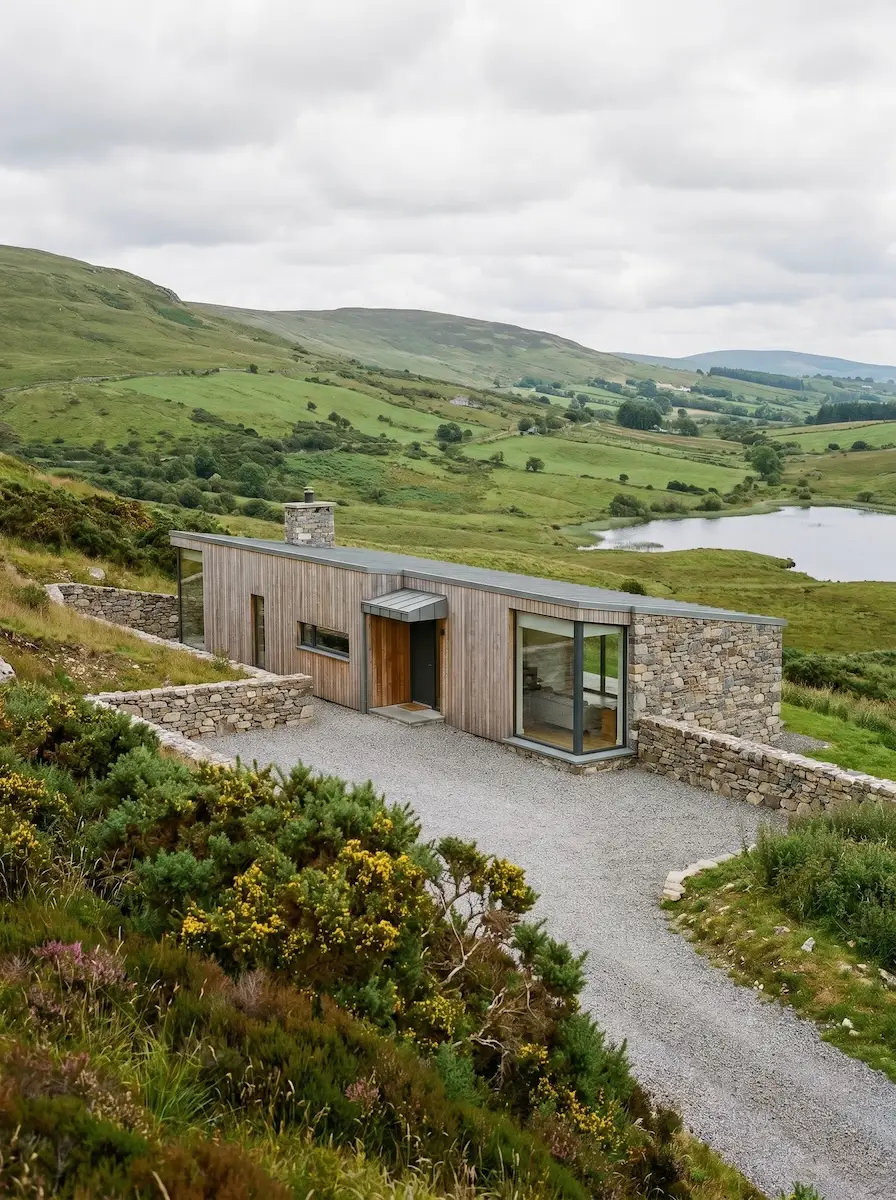
A compact modular home can feel genuinely permanent. That feeling comes from proportion, from the quality of the fabric, from how windows are placed, and from the way the building meets the earth — a clear base, a considered threshold, cladding chosen to weather rather than fade. Lightness is about restraint during construction and care in the detail, not a lighter-weight result. A home built with fewer careless marks usually reads as more settled, not less.
Planning context comes early
It is worth being precise about planning. A modular home is a method of construction, not a planning category. It is not automatically exempt from permission. Whether permission is required depends on the intended use, the size, the location, the local authority’s policy, and the conditions of the specific site.
This is why the planning conversation belongs at the beginning. A permanent rural home, a guest space, a garden studio, and a short-stay retreat are not the same proposition in planning terms, and the documentation and site-suitability questions differ between them. AeroNest’s role here is not to give a planning verdict but to make sure the project is described accurately and early, so the right professionals can be involved before design decisions harden. Clarity at this stage prevents disappointment later.
Access can shape the design
The route a delivery vehicle takes can quietly shape the whole project. Road width, the turn off the public road, gateway openings, the space to manoeuvre or crane a module into place, overhead lines, soft verges, and mature trees all matter. A site that is straightforward to live on is not always straightforward to deliver to.
Access can affect which model is realistic, how modules are sized, and where they are set down. It also affects cost. This is part of why AeroNest reviews access and the delivery route before pricing a project — the same logic behind the studio’s wider approach to what it checks before any formal proposal. A frank look at access early on removes most of the uncomfortable surprises.
The ground tells part of the cost story
Below the visible site there is a second project: foundations, levels, drainage, and the route for services. Rural ground varies. A site may need cut-and-fill to manage a slope, attention to how surface water moves across it, or a longer run to reach existing services. Where mains drainage is not available, a wastewater treatment system has to be considered as part of the plan rather than as an afterthought.
None of this is unusual, and none of it should be alarming. It simply means a portion of the budget belongs to the ground itself. Understanding that early keeps the conversation honest. A model price is a starting point; the site decides how much groundwork sits underneath it, and that should be reviewed before any figure is treated as final.
“Building lightly is not about making a home disappear. It is about making fewer careless marks.”
Shelter, orientation, and privacy matter
Rural comfort is largely about shelter and orientation. The wind in Ireland is persistent and usually has a favoured direction; rain tends to arrive with it. The sun moves across the site on a path that can be planned for. A home that turns its back to the worst weather and opens toward warmth and the best light tends to be calmer to live in and less costly to run.
Privacy and views deserve the same care. Not every view should be framed by a large window — some are better filtered, and some are better kept for the moment you step outside. Existing boundaries and new planting can do quiet work here, though planting should be judged on how it will mature, not how it looks on the day. The rural homes that feel most at ease are usually the ones that respect what was already on the site.
Compact plans can be more generous than oversized ones
A larger house is not automatically a better one. A compact plan, designed with attention, can feel more generous than a sprawling one that was never really thought through. Generosity comes from daylight, from honest storage, from circulation that does not waste space, and from rooms that can do more than one thing across a day and across a year.
This is the thinking behind AeroNest’s modular series. Each model is a considered footprint rather than a maximum one. Window placement, ceiling height, and the relationship between rooms carry more weight than raw floor area. A well-planned compact home also tends to sit more lightly on a rural site — and to cost less to heat through an Irish winter.
Energy performance should be designed in, not added late
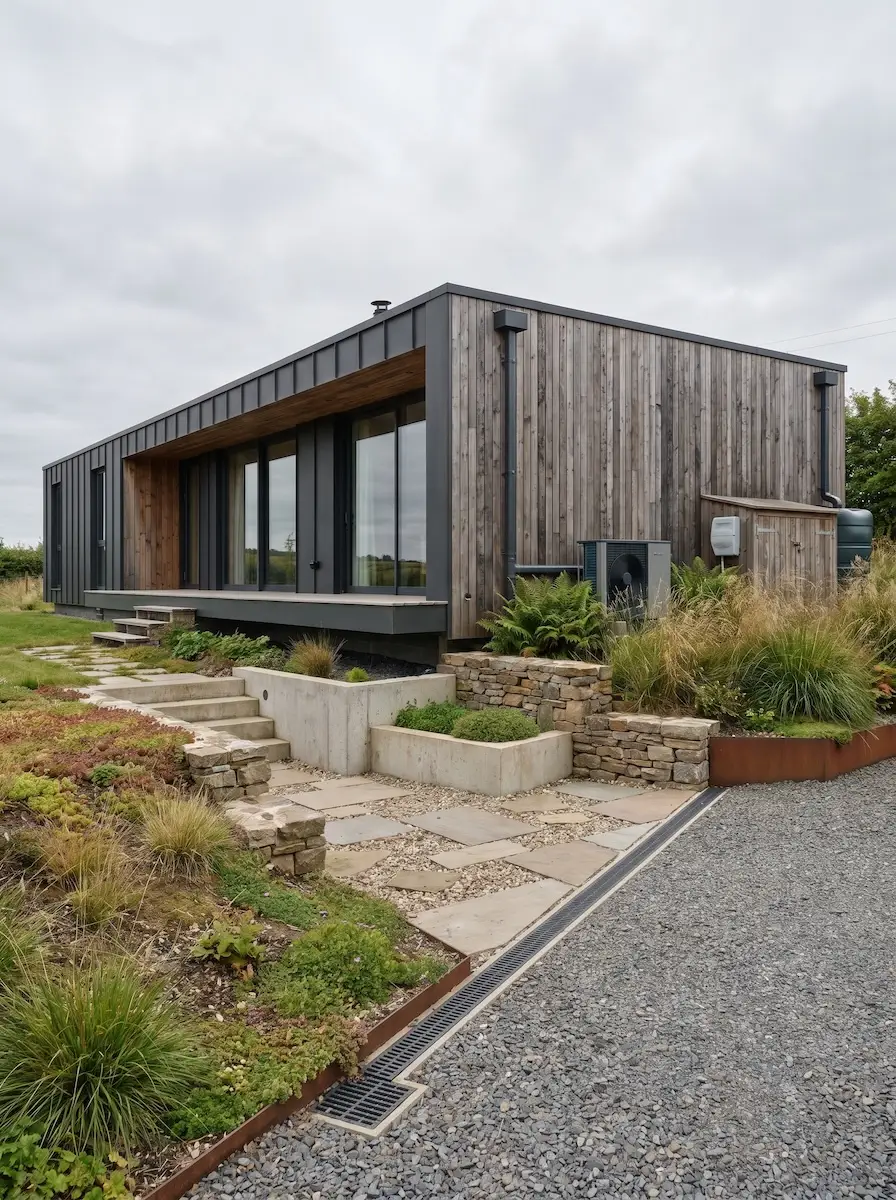
Energy performance is a design decision, not a later upgrade. Insulation levels, airtightness, glazing specification, ventilation strategy, and the heating approach all work best when they are agreed early and treated as one system. Heat-pump readiness, solar PV readiness, and sensible heating controls are easier and less expensive to plan for at the start than to retrofit afterwards.
The right specification depends on the site, the orientation, the budget, and how the home will be used, and parts of it may be subject to professional assessment. AeroNest’s approach is to have these conversations during design rather than after it — which avoids the common outcome where a home is built first and its comfort is negotiated later.
What AeroNest reviews before recommending a model
Before suggesting a particular model, AeroNest looks at a consistent set of practical questions. The aim is to recommend a direction that genuinely fits the site, not the one that is easiest to sell.
- Site location and exposure
- Planning context and intended use
- Access and the delivery route
- Groundworks and site levels
- Water, power, wastewater, and broadband
- Preferred series within the range
- Specification level
- Budget range and a realistic timeline
None of these are unusual questions, but asking them in order — and early — is what keeps a project calm. A recommendation made before these are understood is really just a guess.
Before we sketch, we ask
- Where is the site, and how exposed is it?
- What route does a delivery vehicle need to take?
- Is the project a full-time home, guest space, studio, or retreat?
- What services are already nearby?
- What groundworks are likely before arrival?
- Which views should be held, filtered, or avoided?
- What budget range is realistic before specification begins?
- What timeline is practical rather than hopeful?
A quieter kind of rural build
AeroNest’s role is not to press one house onto every site. It is to help a client choose a modular direction that can arrive with less disruption and settle with more care. A rural home that is right for its ground tends to ask for less attention over the years that follow. It weathers quietly, runs efficiently, and feels as though it belongs.
Building lightly, in the end, is a kind of respect — for the site, for the people who will live there, and for the landscape that was there long before the house. The work is mostly in the early thinking. Done well, it barely shows.
This article is general guidance only. Planning, services, grants, technical assessments, and final pricing depend on the site and should be confirmed with the relevant professionals.